
Trieste: a cultural Mecca
When visiting Trieste, one does get the impression to be in an Italian city. Sharing similarities to Vienna and Budapest, Trieste’s relationship to Austria goes dates from the late 1300s, although it formally rejoined Italy in the early 20th century.
Trieste’s greatest time of renown was during the reign of King Charles VI when it became the Hapsburg Empire’s gateway to the Adriatic Sea and the main point for maritime trade with the East. This allowed it to attracting merchants and citizens from around the world. Over time, this only grew Trieste’s through the significant economic growth of the 19th century.
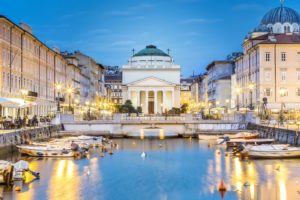
Unique among many European cities of the time, Trieste exhibited a significant climate of tolerance and freedom. Even from ancient Roman times, many religious, cultural and urban traces left by the diverse cultures and ethnic groups that lived in Trieste helped build the rich mosaic of the city’s history.
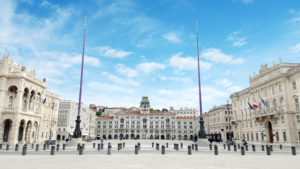
Traces of this are most manifest in the architecture of the town which feature striking neoclassical, renaissance and even medieval buildings that emblazon the streets of Trieste’s streets. Truly notable is the Piazza Unità which is the physical and spiritual center of this cosmopolitan growth. Around the square are stunning examples of neo-classical architecture, such as the Palazzo del Governo, the Palazzo Stratti (headquarters of the Generali Insurance Company), the Palazzo del Municipio (city hall), and the Palazzo Lloyd Triestino.
Multicuturalism and tolerance are also touchstones of the city. Churches, temples and synagogues dot the landscape and give those of all faiths a place to worship while delighting the senese of tourists. Some of these include The Greek-Orthodox church of San Nicolò, the Serbian-Orthodox church of San Spiridone, the via San Francesco Synagogue, the Evangelical Church in Largo Panfili (Augustan confession), and the San Silvestro Waldensian church (Helvetic confession) which are some of the most visited places in the city.
In this same vein, Trieste’s culinary traditions benefits from this admixture of cultures: Germanic, Austrian, Slavic, Hungarian and Greek influences intermingle in a unique way. A visit to Trieste is a trip for the taste buds as you enjoy the different flavours and texures from across this broad cultural background: Ranging between the osmizze, a rare Slovenian treat. located in the Carso plateaus where during short periods one can visit small private homes/shops that feature local dishes and wines such as Terrano, Vitovska or Malvasia can be tasted. And of course, what’s not to love about the the famous Viennese, Habsburg style 19th century caffès, such as Caffè Tommaseo and Caffè San Marco. These offer Viennese pastries such as Strudels, Sacher, Presnitz, Putizza, Pinza or Rigojanci served with a coffee prepared and served in several ways unique to Trieste.
Lastly, great writers have emerged from Trieste’s diverse heritage. Walking through the city streets, one can see places and atmospheres described in the works of authors like Italo Svevo, Scipio Slataper, Umberto Saba, Claudio Magris, Fulvio Tomizza, just to name a few. Irish novelist James Joyce, who lived in the city on and off from 1904 to 1920 considered it a second home. He finished writing Dubliners and A Portrait of the Artist as a Young Man in Trieste and it is also there that he wrote the most significant chapters of his masterpiece Ulysses. A bronze statue of him now stands on the bridge that crosses the Canal Grande. Poet Umberto Saba’s statue, with his legendary pipe, is located at the end of San Nicolò street, not far from his historic bookstore, the Libreria Antiquaria, while novelist Italo Svevo’s statue stands in Piazza Hortiz.